Managing Business Property Taxes on the Asset Level

Most businesses track property taxes as a single line item, and that means most businesses are missing the full picture.
The way most businesses manage business personal property (BPP) tax today looks something like this: a spreadsheet, a stack of returns filed by jurisdiction, and a lot of manual data management every spring. It works, until it doesn’t. Assets get missed. Values get overstated. Deadlines slip. And because no one is looking at the data asset by asset, errors compound silently for years.
Why the Asset Level Matters
BPP taxes are assessed based on the reported value of your taxable assets, rolled up into a single number based on categories and years. Every piece of equipment has a purchase date, an original cost, a location, and an associated jurisdiction. When businesses manage BPP tax at a high level, totaling up costs and filing without tracking each asset individually, errors slip through undetected – and those errors can result in real dollar costs.
Consider just a few scenarios where asset-level tracking makes a measurable difference:
- Ghost assets — equipment that has been disposed of or sold but is still being reported and taxed as active.
- Property that’s been moved between jurisdictions is being filed in the wrong location.
- Acquisitions are being reported at incorrect cost or in the wrong tax year.
None of these are rare edge cases. They’re the everyday reality for any organization managing a large or distributed asset portfolio without the right tools.
The Challenge of Scale
For a small business with 20 assets in one county, tracking at the asset level is manageable. For larger companies with hundreds, or even thousands, of assets spread across multiple jurisdictions or states, it becomes an operational challenge as they continue to scale in size.
Multi-location businesses face a patchwork of filing deadlines, exemption rules, and tax rates that vary not just by state, but by county. Manual efforts required to manage are significant, and the margin for error is wide. This is where the value of purpose-built software becomes clear very quickly.
What Asset-Level Management Actually Looks Like
True asset-level property tax management means having a clear, current picture of every taxable asset in your portfolio; what it is, where it is, what it cost, which jurisdiction it sits in, and how it’s being reported. It means having that documentation accessible and ready if the roll-up numbers need to be defended. It also means being able to answer the question every CFO eventually asks: “Are we paying exactly what we owe — and not a dollar more?”
A Smarter Approach Starts Here
TaxScribe™ is built specifically for businesses that are serious about managing property tax at the asset level. From centralized asset tracking to multi-jurisdiction filing support, TaxScribe gives your team the visibility and control to manage BPP tax with confidence, not guesswork.
Here’s what TaxScribe™ brings to your workflow:
Form Generation — Generate tax forms directly from your asset data, so there’s no manual re-entry when filing season arrives.
CSV Asset Import — Bulk import your existing asset data via CSV, so you’re up and running without starting from scratch.
Asset Classification — Classify uncategorized assets with AI in one click, so every asset lands in the right schedule category.
Multi-Client & Location Management — Organize assets across multiple clients, locations, and tax jurisdictions from a single Asset Manager view.
Asset Schedule Categories — Assets are automatically organized into the categories your returns require, including Additions & Deletions, Fully Depreciated Assets, Leased Personal Property, and more.
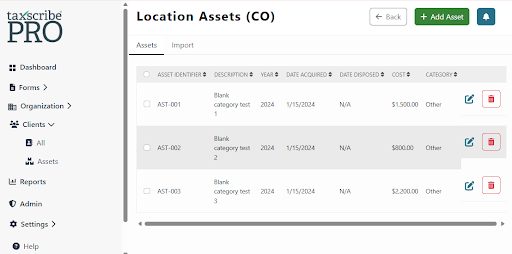
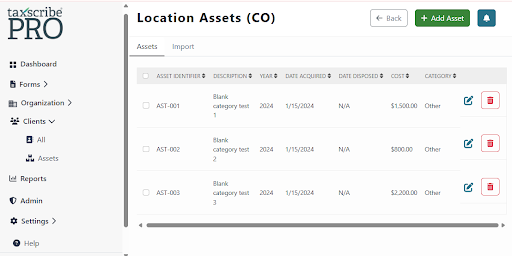
Every asset, every location — track assets by identifier, description, year, acquisition date, disposal date, cost, and category across all your locations.
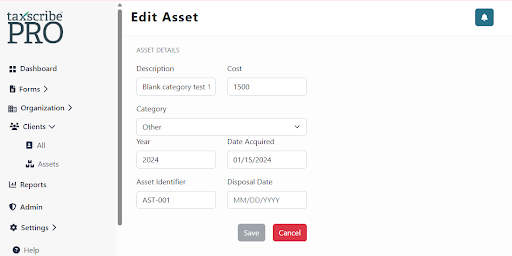
Full asset-level control — update description, cost, category, year, asset identifier, and disposal date all in one place.
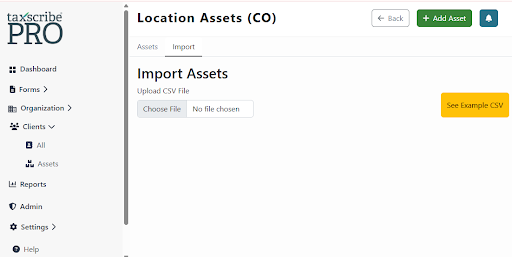
Import assets in bulk via CSV — upload your existing asset data with an example CSV template available to get started quickly.
Asset overview — all clients and locations in one place, with asset counts at a glance.
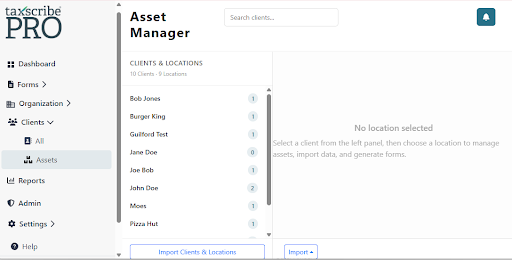
Select a client and location to manage assets, import data, classify uncategorized items, and generate forms — all from a single screen.
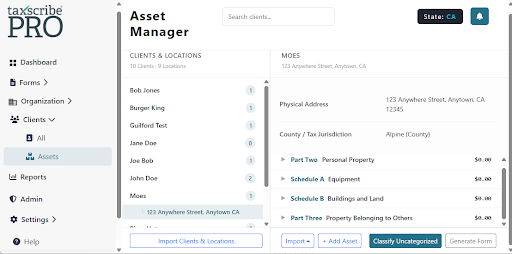
Manage clients across multiple locations and tax jurisdictions — assets organized by county with schedule categories and form generation built in.
Final Thoughts
Every jurisdiction has a deadline. Every asset has a cost. And every error in between is money your business shouldn’t be paying. TaxScribe gives your team the visibility to get it right — accurate filing locations, correct acquisition reporting, and asset-level detail that holds up under scrutiny. When filing season arrives, you won’t be guessing. You’ll be ready. Schedule a demo today. Email marissa.kumar@reason.consulting to get started.